Why Choose PBT Bristles for Toothbrush Manufacturing?
- Share
- Issue Time
- Aug 18,2026
Summary
Learn why PBT bristles suit toothbrush manufacturing, offering low moisture absorption, good resilience, shape retention, and flexible design options.
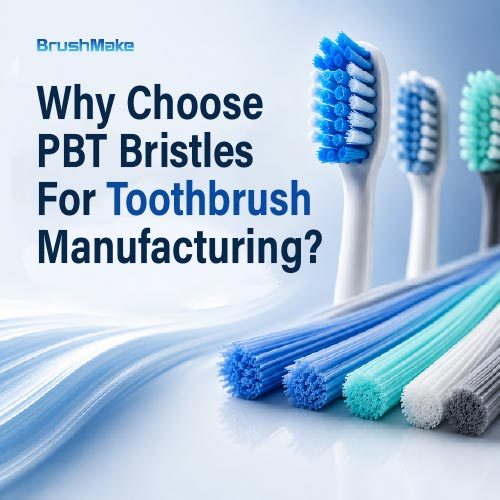
For toothbrush manufacturers, choosing the right toothbrush filament is about achieving the desired brushing performance, production stability, and product positioning—not simply selecting another type of plastic brush filament. PBT (Polybutylene Terephthalate) has become a widely used material in manual and electric toothbrushes because it combines low moisture absorption, good resilience, and reliable processing performance. These characteristics make it particularly suitable for products that must perform consistently in wet environments while meeting modern consumer expectations for comfort and durability.
Low Moisture Absorption Improves Real-World Toothbrush Performance
Unlike many plastic products, toothbrushes spend their entire service life in a wet environment. Every brushing cycle exposes the filament to water, toothpaste, saliva, and repeated drying, making moisture absorption an important factor in long-term performance.
PBT is valued because it absorbs significantly less moisture than many nylon grades, helping maintain more stable mechanical behavior after repeated exposure to water.
Why this matters for manufacturers
A toothbrush designed with carefully controlled filament diameter and tuft geometry should deliver a consistent brushing feel throughout its intended service life. Lower moisture absorption helps reduce unwanted changes in flexibility and stiffness caused by wet conditions, allowing manufacturers to produce brushes with more predictable performance.
Key manufacturing benefits:
· More stable brushing feel during daily use
· Better dimensional stability in wet environments
· Consistent performance across different climates
· Reliable production quality for mass manufacturing
Rather than viewing low moisture absorption as only a material specification, manufacturers should consider how it contributes to a more consistent finished product.
Good Resilience Helps Preserve Brush Head Geometry
Every PBT bristle bends thousands of times during normal use. The ability to recover after repeated bending is critical for maintaining the intended brush-head structure. PBT provides a useful balance between flexibility and structural support, making it suitable for products that require controlled softness without sacrificing stability.
Design factors matter as much as the material
The final brushing experience depends on multiple design variables working together: Filament diameter, Filament length, Tip configuration, Taper design, Tuft density, Brush-head layout
For example, reducing diameter increases flexibility, while tapered tips create a softer contact point without requiring an entirely different material. For manufacturers, the real design equation is:
PBT material + filament specification + brush-head design = final brushing performance.
This application-oriented approach is more valuable than selecting a material based on marketing claims alone.
Controlling Bristle Splaying for Longer-Lasting Products
One of the clearest signs of toothbrush wear is bristle splaying, where filaments gradually spread outward and lose their original alignment. This affects both product appearance and brushing consistency.
PBT's dimensional stability makes it a practical choice for manufacturers seeking better shape retention. However, technical accuracy is important—PBT is not immune to wear. Clinical research has shown that PBT toothbrushes experience reduced stiffness and increased splaying after extended use, although the rate of change depends heavily on brush design and usage conditions.
What manufacturers should optimize
Instead of promising that bristles will never deform, manufacturers should focus on controlling wear through: Appropriate filament diameter, Balanced tuft density, Proper tip finishing, Suitable filament length, Product-specific stiffness design
This engineering approach produces a more credible and durable toothbrush solution.
Balancing Softness and Cleaning Performance
Modern consumers expect toothbrushes to feel gentle while still cleaning effectively. Achieving this balance requires much more than selecting a softer material. Softness is influenced by several design elements: Filament diameter, Taper ratio, Tip rounding, Tuft arrangement, Material modulus. PBT allows manufacturers to create multiple performance levels from the same material platform.
Standard PBT Filament
Suitable for everyday toothbrushes that require durability, controlled stiffness, and efficient production.
Fine-Diameter PBT Filament
Provides greater flexibility for softer brushing concepts.
Tapered PBT Filament
A tapered toothbrush filament creates finer contact points, making it particularly suitable for: Sensitive-care toothbrushes, Children's toothbrushes, Premium oral-care products, Fine-tip cleaning designs
This flexibility allows manufacturers to differentiate products without completely changing their production process.
How to Choose the Right PBT Bristles Supplier
Selecting a PBT bristles supplier is ultimately about finding a partner who understands finished toothbrush performance—not simply someone who sells filament by diameter.
What manufacturers should evaluate
Technical knowledge: A qualified supplier should understand the performance differences between PBT, PA612, PA610, PP, and other toothbrush filament materials.
Customization capability: Look for suppliers that can provide customized: Diameter, Color, Length, Taper ratio, Tip finishing, Packaging
Production consistency: Reliable suppliers maintain stable specifications across production batches, helping reduce quality variation during mass manufacturing.
Application-focused support: The best suppliers discuss the finished toothbrush—not just the filament specification.
Why BrushMake takes an application-first approach
At BrushMake, we start with the finished toothbrush rather than treating filament as a standard commodity. We evaluate the target user, brushing feel, production process, and cost requirements before recommending suitable PBT bristles or alternative materials.
Whether you're developing a children's toothbrush, a premium oral-care product, or a high-volume OEM project, our customized toothbrush filament solutions help manufacturers balance performance, production efficiency, and cost.