Why Choose PA612 Brush Filament for Wet Environments?
- Share
- Issue Time
- Oct 30,2026
Summary
A practical guide to moisture absorption, wet stiffness, suitable brush applications, material limitations and alternatives.
Nylon bristles can soften as they absorb water. Compared with PA6 and PA66, PA612 contains longer hydrocarbon segments and generally absorbs less moisture, helping a brush retain more consistent dimensions, working stiffness and elastic recovery after repeated washing, spraying or immersion. This is why PA612 brush filament is frequently evaluated for oral-care, food-cleaning, tube-cleaning and other wet-use brushes. Nylon contains polar amide groups that attract moisture. Absorbed water increases molecular-chain mobility and acts as a plasticizer, so a nylon bristle may bend more easily when wet. Its dimensions and recovery behavior can also change. This may benefit gentle cleaning, but it can reduce cutting or scrubbing efficiency when the brush design has little stiffness margin. PA612 has longer hydrocarbon sections between its amide groups than PA6 or PA66. With fewer moisture-attracting groups per unit of chain length, it generally takes up less water and maintains its dimensions more consistently. PA612 is still a moisture-absorbing polyamide, however, and should not be described as waterproof. The figures below come from a third-party brush-material guide and illustrate relative behavior. They are not guaranteed specifications for every commercial filament or finished brush. Fine filaments must combine gentle contact with reliable bend recovery. PA612 can help limit excessive softening and tuft splay after repeated wetting, while final softness remains dependent on diameter, free trim length, end treatment and tuft density. Repeated washdown can change cleaning pressure. Lower moisture uptake helps reduce variation in filament dimensions and working stiffness. Food-contact suitability must still be confirmed for the exact resin grade, colorants, additives and operating conditions. These brushes depend on controlled outer diameter and wall contact. PA612 provides a useful balance of flexibility, recovery and wet dimensional stability, but the complete tufted or twisted-wire assembly should be tested for insertion force. Floor-care, vehicle-wash and industrial brushes need consistent pressure over repeated cycles. PA612 is most valuable when wet stability, durability and performance consistency justify a higher material cost than PET or PP. PA612 offers predictable wet performance rather than the highest dry stiffness. It is normally more expensive than PA6, PA66, PBT, PET and PP; it still absorbs moisture; and its chemical compatibility and compliance status must be verified for the actual grade and color. The correct question is not whether PA612 is universally better, but whether its wet-state stability creates enough value for the finished brush. Compare the same brush after dry conditioning, high-humidity conditioning, and immersion or repeated washing. Record dimensional change, deflection under a fixed load, recovery after unloading and permanent tuft splay. When detergents, sanitizers, acids or alkalis are involved, repeat the test using the actual concentration, temperature and contact time. BrushMake supplies PA612 brush filament from 0.05 to 1.2 mm in straight or crimped forms, with custom cut lengths, colors and cross-sections. Share your brush application, diameter, trim length, water temperature, chemical exposure, documentation needs and estimated volume. Our team can help define a practical specification and support sample testing before mass production.Why Choose PA612 Brush Filament for Wet Environments?
Why Water Changes Nylon Bristles
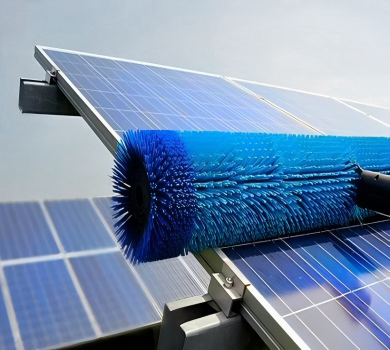
Wet-vs-Dry Performance Data
Reported property PA6 PA66 PA612 Moisture content at 50% RH 2.7% 2.5% 1.3% Moisture content at 100% RH 9.5% 8.5% 3.0% Wet/dry filament modulus ratio 0.50 0.35 0.72 Brushes That Benefit from PA612
Oral and Personal Care
Food and Conveyor Cleaning
Bottle, Tube and Precision Brushes
Wet Industrial Cleaning
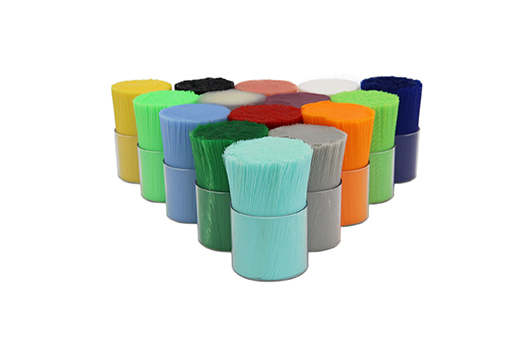
Limitations and Alternative Materials
Validate the Finished Brush, Not Only the Resin
Develop Your PA612 Filament with BrushMake
References