How to Choose the Right PBT Bristles for Toothbrush Production
- Share
- Issue Time
- Aug 20,2026
Summary
Learn how to choose the right PBT bristles for toothbrush production, from filament diameter and taper to tip design, durability, and supplier quality.
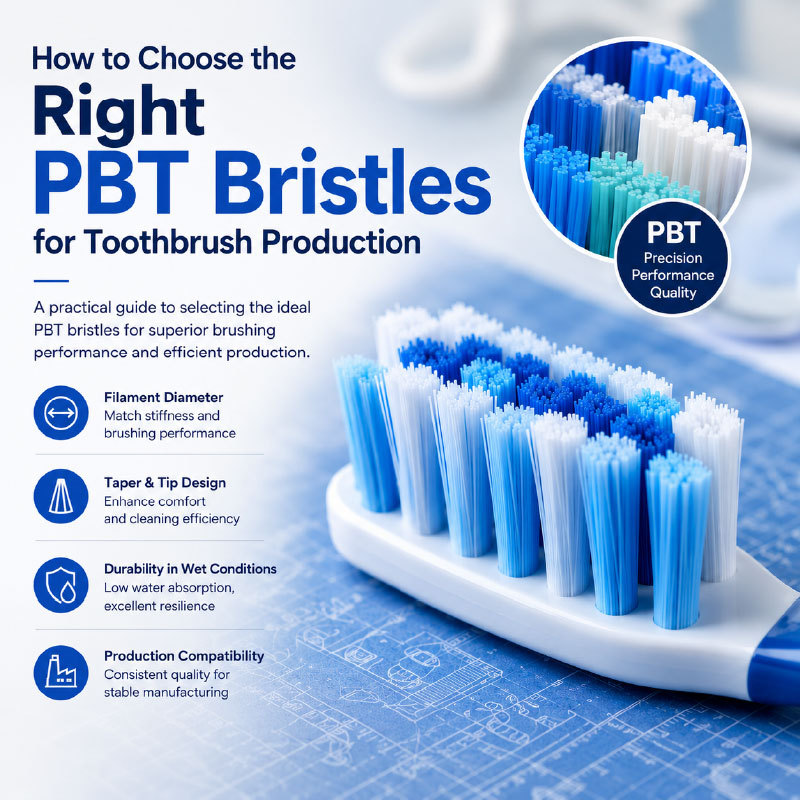
PBT (polybutylene terephthalate) is widely used as a toothbrush filament because of its low moisture absorption, good resilience, wear resistance, and dimensional stability. However, the most suitable PBT specification depends on the toothbrush application, target brushing feel, and manufacturing process.
Start With the Toothbrush Application
The first step is to define the performance requirements of the finished toothbrush.
For standard adult toothbrushes, manufacturers generally need a balance of cleaning performance, stiffness, durability, and production efficiency. Non-tapered PBT filaments with stable dimensions are often suitable for these applications.
For soft and sensitive-care toothbrushes, flexibility and tip geometry become more important. Fine or tapered PBT filaments can provide a gentler contact point while maintaining adequate strength at the filament base.
For premium toothbrushes, manufacturers may require finer filaments, controlled tapering, consistent tips, and tighter dimensional control to achieve a more refined brushing experience.
The same PBT material can therefore require different specifications depending on the final product.
Select the Right PBT Filament Diameter
Filament diameter is one of the primary factors affecting bristle stiffness and flexibility. In general, smaller diameters produce more flexible filaments, while larger diameters provide greater stiffness.
As a practical starting point, 0.15–0.20 mm PBT filaments may be considered for soft toothbrush designs, 0.18–0.22 mm for medium brushing performance, and 0.20–0.25 mm for firmer configurations. Finer diameters below 0.15 mm can be considered for specialized soft or premium designs. These ranges should not be treated as fixed standards. Filament length, tuft density, number of filaments per tuft, and tip geometry can significantly change the final brushing feel. For this reason, manufacturers should evaluate diameter together with the complete tuft configuration rather than selecting a filament based on diameter alone.
For mass production, diameter consistency is equally important. Variations between batches can change tuft stiffness and create differences in the finished toothbrush. Controlled extrusion and stable diameter tolerance are therefore important supplier-selection criteria.
Match Filament Structure and Tip Design to the Product
The combination of filament structure and tip design has a direct influence on brushing feel, flexibility, and application suitability.
Non-tapered PBT bristles maintain a relatively consistent diameter along the filament. They are suitable when manufacturers prioritize stable stiffness, durability, predictable tufting behavior, and efficient large-scale production.
Tapered PBT bristles gradually become finer toward the working end. The reduced tip diameter can increase flexibility at the contact point and is particularly useful for soft, sensitive-care, children's, and premium toothbrush designs.
For tapered PBT, manufacturers should specify the base diameter, taper length, tip diameter, and total filament length together. These parameters determine how the filament bends and how much support remains at the base. Tip processing is equally important. End-rounded tips are suitable when a smooth and controlled contact surface is required, while tapered or fine-tapered tips can be considered when a finer contact point and softer brushing experience are desired. A thinner tip does not automatically create a softer toothbrush. The final result depends on the interaction between diameter, taper, length, stiffness, and tuft configuration.

Non-tapered PBT bristles
Consider PBT Performance in Wet Conditions
Toothbrush filaments operate under repeated wet and dry conditions and are exposed to water, toothpaste, saliva, mechanical bending, and drying. PBT's relatively low moisture absorption can help maintain stable filament dimensions and mechanical behavior during wet use. This makes PBT an attractive option for toothbrushes where consistent performance over repeated brushing cycles is important. However, manufacturers should evaluate more than moisture absorption. A complete assessment should include elastic recovery, abrasion resistance, stiffness, tip durability, and shape retention. The objective is not to select the material with the highest individual performance, but to achieve the right balance for the finished toothbrush.
Validate the Filament on the Production Line
A high-quality toothbrush filament must also perform consistently during manufacturing. Before mass production, manufacturers should test filament feeding, cutting, tufting, trimming, bristle height, and tuft appearance. Filament straightness, length consistency, diameter tolerance, and tip quality can directly affect production efficiency and finished-brush consistency. For OEM projects, batch-to-batch stability is particularly important. Once a filament specification has been approved, future orders should reproduce the same diameter, color, length, tip condition, and mechanical performance. This is why choosing a pbt bristles supplier should involve more than comparing price per kilogram. Technical support, sample validation, customization capability, quality control, and repeat-order consistency should all be considered.
PBT Bristle Selection Checklist
Before approving a pbt bristle for production, evaluate: Application → Diameter → Length → Stiffness → Filament Structure → Tip Design → Tufting Compatibility → Batch Consistency
The right PBT bristle is the specification that delivers the required balance of cleaning performance, comfort, durability, and manufacturing stability. For toothbrush manufacturers looking for a reliable pbt bristles supplier, BrushMake can provide material selection support and customized toothbrush filament solutions according to your product and production requirements. Explore BrushMake's Toothbrush Filaments Application range or contact our team to discuss your PBT bristle requirements.